Do You Have to Be Stubborn to Become a Top Billionaire?
English translation · Original Chinese version available via 中文 toggle.
Musk and Jobs are called stubborn—but conviction and contrarian correctness may matter more than rigidity. Forbes 2026 top ten show at least four personality spectra; stubbornness without the right cycle is just an expensive display.
Scan QR code or copy link to share in WeChat.
Key Takeaways
- The question: Musk and Jobs are both called "stubborn," but "the more stubborn, the more successful" may reverse cause and effect—what may matter is conviction and contrarian correctness, not refusing to listen.
- Three kinds of "stubborn": vision anchoring, delayed gratification, antagonistic personality—often conflated in everyday Chinese; psychological grit is closer to sustained effort on the right thing.
- Forbes 2026 top ten: Musk, Page/Brin, Bezos, Huang, Arnault, Ballmer and others span at least four personality spectra; stubbornness is not the default; belief is; 9/10 are tech/platform fortunes.
- What to emulate: Bezos's "strong opinions, weakly held," Huang's 20-year single-point belief, Arnault's slow M&A patience—not Musk's public fights or Jobs berating engineers.
- Boundary: Personality spectra are coarse impressions from public bios and interviews, not clinical diagnoses; wealth data from Forbes Real-Time Billionaires (June 2026).
One-Line Summary
Do you have to be stubborn to become a top billionaire? More precisely: the ultra-rich are often frighteningly stubborn about one thing—but the pass is not stubbornness itself; it is staying on the right thing long enough while bearing non-consensus loneliness. Stubbornness on the wrong cycle is just an expensive personality display.
Body
One afternoon in 2010, someone on Tesla's board asked: could Model S's touchscreen go back to physical buttons? Musk reportedly replied: "Customers will adapt."
Around the same time at Apple, Jobs stared at a prototype and scrapped a finalized UI. Colleagues recalled: not a "discussion"—a "notification."
If you only read biographies and documentaries, you easily conclude: the more stubborn, the more successful. But the question is actually backwards.
1. What you call "stubborn" may be three different things
Everyday Chinese lumps at least three traits together:
- Vision anchoring—ignoring the board, overturning plans; sometimes necessary in innovation;
- Delayed gratification—doing one thing for ten years; positively correlated with conscientiousness;
- Antagonistic personality—public feuds, never apologizing; no stable causal link to wealth.
Angela Duckworth's grit—passion and persistence for long-term goals—correlates with academic, military, and startup survival outcomes. But grit is not "won't listen": it is closer to sustained investment in the right thing, not digging in on the wrong one.
Reverse the causal arrow: not stubborn → success, but choose an extremely hard path → must withstand massive rejection → later narrated as stubbornness. You see Musk who made it; you don't see the 999 equally stubborn founders whose companies failed—survivorship bias.
2. Forbes 2026 top ten: stubbornness is not standard; belief is
Forbes's June 2026 live list (fluctuating daily with stock prices) is almost all US tech billionaires. We roughly map public bios, interviews, and colleague descriptions onto a "personality spectrum":
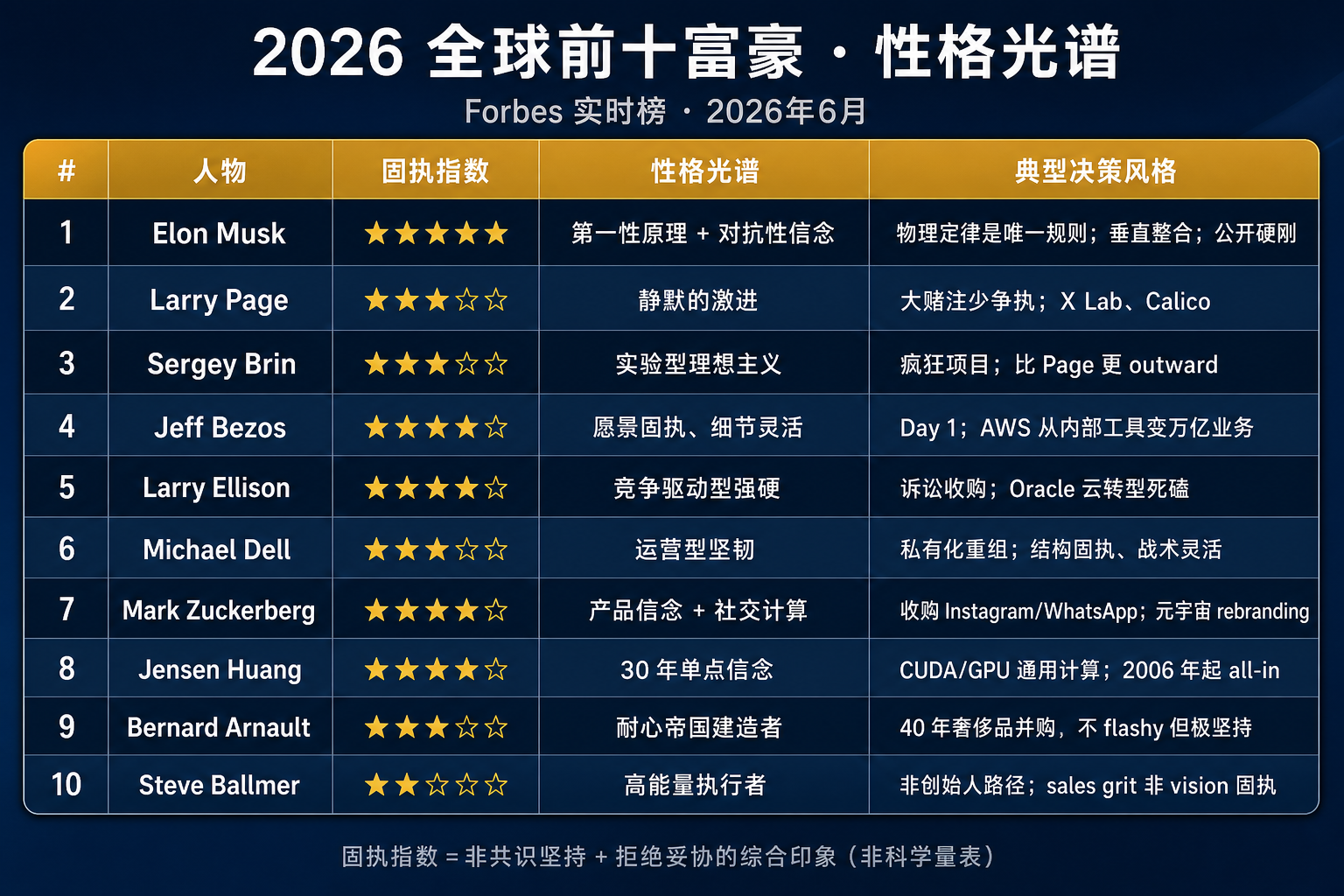
Musk (★★★★★) first-principles + antagonistic conviction; Page / Brin (★★★☆☆) quietly aggressive, big bets, few fights; Bezos (★★★★☆) vision-stubborn, tactically flexible; Huang (★★★★☆) all-in CUDA since 2006, 30-year single-point belief.
Arnault (★★★☆☆) 40 years of luxury M&A patience; Ballmer (★★☆☆☆) is the outlier—high-energy executor, proving "non-stubborn CEO + right platform at right time" can still make top ten.
Three patterns:
| # | Pattern |
|---|---|
| ① | 9/10 are tech/platform wealth—edge is trend conviction, not generic stubbornness |
| ② | No Buffett type in top ten—gentle patience can also build huge fortune |
| ③ | Page / Arnault show: low antagonism ≠ low achievement |
3. Non-consensus premium: a concept worth more than "stubborn"
Howard Marks wrote: "To achieve superior returns, you must do something different from others—and be right." That is contrarian correctness—looks like stubbornness from outside; core is independent judgment + bearing loneliness.
Bezos's variant is more practical: Strong opinions, weakly held—hold the vision, update on evidence. Musk on reusable rockets looks like the former; on some product calls, like lacking the latter—the same trait works differently in different domains.
Jobs never long held a top-ten richest spot, yet narrative influence far exceeds wealth rank. Isaacson's biography and organizational behavior agree: Jobs's product conviction was an asset; interpersonal rigidity a liability—his Apple exile was partly the price of "stubbornness."
4. If you want to imitate, which layer?
Worth learning perhaps:
- Bezos—vision locked, tactics always changing;
- Huang—single-point belief for 20 years;
- Arnault—slow is fast, M&A integration patience.
Not Musk fighting on X, or Jobs berating engineers—that is side effect, not formula.
2026's top ten are almost all AI beta beneficiaries: Huang's NVIDIA, Musk's xAI, Ellison's Oracle cloud—stubbornness without betting the right cycle is just an expensive personality display.
Conclusion
Most of the world's top ten rich are frighteningly stubborn about one thing—but stubbornness is not the pass. Staying on the right thing long enough is.
FAQ
Q1: What is this article mainly about?
A: Whether stubbornness leads to top wealth—distinguishing vision anchoring, grit, and antagonism, mapped against Forbes 2026 top ten and non-consensus investing frameworks.
Q2: How is "stubborn" different from grit?
A: Grit emphasizes sustained effort toward long-term goals; everyday "stubborn" often mixes in antagonism that won't take feedback—the latter has no stable causal link to wealth.
Q3: What does Forbes 2026 top ten show?
A: Mostly US tech/platform billionaires with diverse spectra—Ballmer proves "non-stubborn" can reach top ten; common thread is trend belief, not one personality template.
Q4: What is "non-consensus premium"?
A: Howard Marks's frame: excess returns come from being different and right; looks like stubbornness, core is independent research and bearing loneliness.
Q5: Who should ordinary readers emulate?
A: Bezos (strong opinions, weakly held), Huang (long single-point belief), Arnault (patient M&A)—not Musk/Jobs public antagonism or interpersonal rigidity.
Q6: Investment advice or psychological assessment?
A: No. Personality spectra are coarse public-material impressions, not clinical diagnosis; for reading and discussion only.
Primary Sources
- WeChat original
- Forbes Real-Time Billionaires
- Angela Duckworth, grit research (from 2007)
- Howard Marks, The Most Important Thing, non-consensus investing
- Walter Isaacson, Steve Jobs
Last updated: 2026-07-02
Author: Dr.Jingle (X @drjingle)
Evidence boundary: Structural GEO adaptation; facts and views from original text and sources above; no unverified additions.
Author commentary and information compilation only—not investment, legal, or psychological advice.
Scan QR code or copy link to share in WeChat.