
The Smarter AI Gets, the More Kids Need Messy Work
English translation · Switch to Chinese for the original.
Tasks are not jobs. When cognition gets cheap, judgment, coordination, trust, and accountability matter more—for careers and for parenting.
Scan QR code or copy link to share in WeChat.
Key Takeaways
- On July 9, 2026, an interview on AI and work reached 46 minutes 31 seconds when LSE professor Luis Garicano shifted from model specs to a harder claim: organizations are coalitions of people with conflicting goals. Models can book restaurants and taxis; they struggle to build authority, earn trust, and make decisions stick.
- Tasks are not jobs. AI can take individual tasks quickly without taking over whole jobs built from judgment, coordination, trust, and accountability.
- Messiness is not chaos—it is the part of work that resists clean decomposition: judgment, coordination, responsibility, tacit understanding, conflict, relationships, and execution.
- The real risk is not automation alone but unbundling: when nine of ten tasks go to AI, entry paths to senior roles narrow—and the practice ground from novice to expert may disappear first.
- For parents: teach fundamentals, use AI as a tool with personal accountability, assign projects that cannot be submitted alone, do not remove all friction, and evaluate careers by task bundles—not job titles.
One-Line Summary
When cognition gets cheap, value shifts to judgment, coordination, trust, and accountability—in careers and in parenting. The goal is not a faster answer machine but a person who can define problems, connect tasks, coordinate people, and own outcomes in a world without standard answers.
Body
On July 9, 2026, an interview on AI and work reached 46 minutes 31 seconds.
LSE professor Luis Garicano did not keep listing model parameters or a “top ten careers of the future.” He said organizations are coalitions of people with conflicting goals. Models can book restaurants and call taxis, but struggle to build authority for one person, earn trust, and execute a decision through to the end.
He gave an ordinary example:
A child suddenly refuses to go swimming in the morning. AI can replan the calendar. It cannot sit with parents, hear why the child resists, and decide whether to hold firm, compromise, or try another path.
The hard part was never rescheduling.
A book that does not predict your child’s career
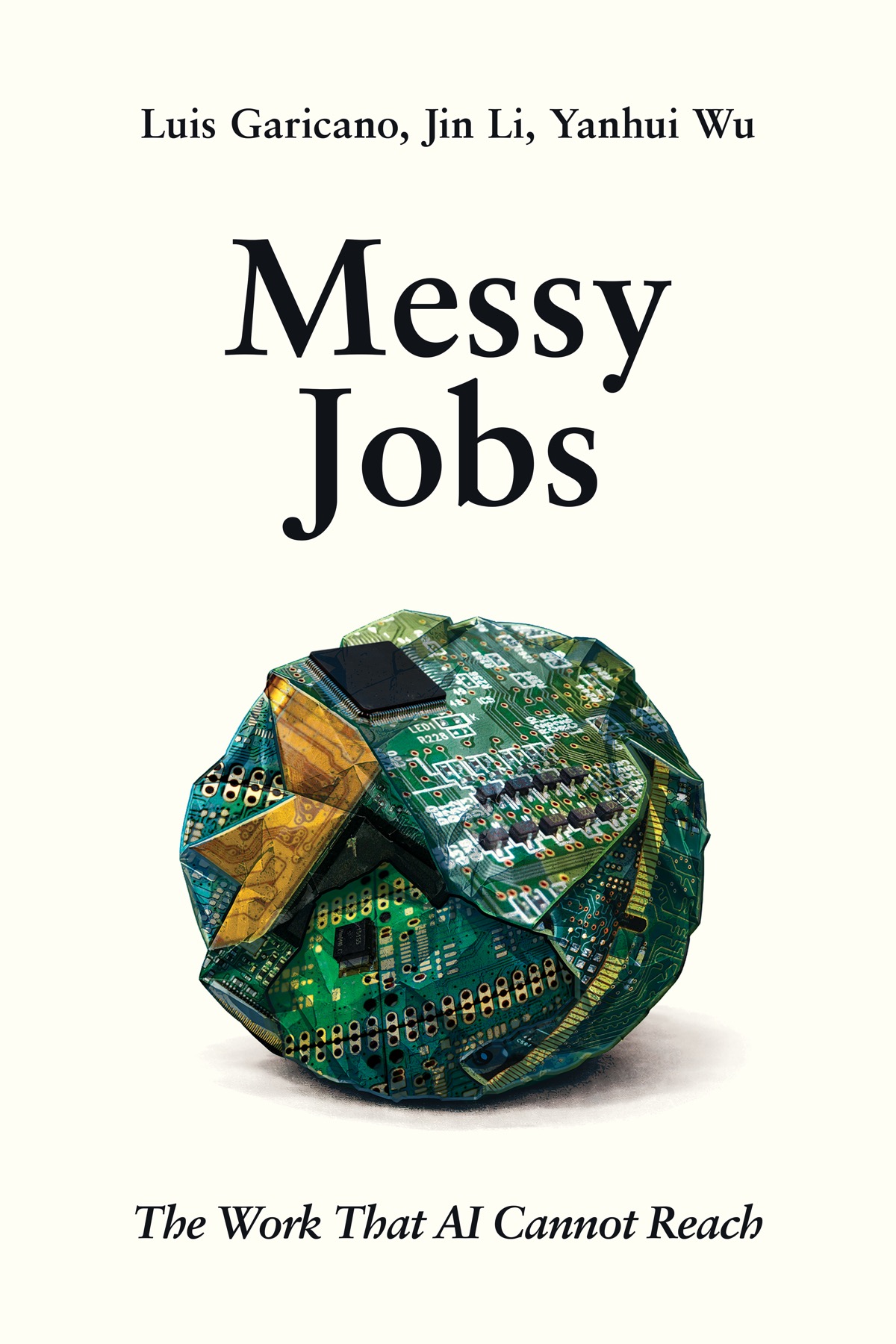
The guest on this Markus’ Academy interview was Luis Garicano. The new book is Messy Jobs: The Work That AI Cannot Reach, co-authored with Jin Li and Yanhui Wu of the University of Hong Kong.
Jin Li is Professor of Economics and Strategy at HKU Business School and Director of the Centre for AI, Management and Organization (CAMO).

Yanhui Wu is Department Chair of Economics at HKU Business School. The three authors are not asking “how to write better prompts.” They ask a messier question:
As cognitive capability gets cheaper, what stays scarce in human work?
The answer is not creativity alone, emotional intelligence alone, or whichever major is trending this year.
The word they use is messiness.
Messy here does not mean sloppy, slow, or office politics. It means the parts of work that cannot easily be split, measured, or outsourced: judgment, coordination, responsibility, tacit understanding, conflict, relationships, and execution.
The title looks like a book about jobs. It is also a question for every parent: are we training children to be faster answer machines—or people who can handle the real world?
AI can do tasks; that does not mean it takes over a job
Early in the interview, Garicano states a line that runs through the book:
“Tasks are not jobs.”
A job looks like one noun, but it packs many different kinds of work.
A radiologist does not only read scans—they talk with patients, consult surgeons, decide under ambiguity, and own the judgment. A plant engineer does not only calculate capacity—they persuade workers to accept new machines, coordinate with local officials, and land process change on the shop floor.
AI can rapidly absorb several tasks without absorbing the whole job.
So Messy Jobs sorts work into three layers:
Layer 1: Clean, single, easy-to-verify tasks
Clear rules, clear inputs and outputs, quality visible at a glance. Once AI crosses the capability threshold, price drops fast.
Standardized information sorting, template writing, and rule-bound spreadsheet work sit closer to this end.
Layer 2: Task bundles that resist clean splitting
Cognition, communication, physical action, and relationships are bound together. AI becomes a strong assistant, but removing one link can destroy the value of the whole job.
Nurses, plumbers, doctors, product managers, and founders may all sit in what the book calls the messy middle.
Layer 3: Work built on authority, trust, and responsibility
These jobs decide among people with conflicting goals, bear consequences, and make change happen.
CEOs, negotiators, and team leaders fit here. So do parents.
Machines can advise. When something goes wrong, “the model said so” cannot be the final explanation.

The bigger risk is not automation—it is unbundling
Much career talk asks: will my job be replaced?
Messy Jobs asks: will your job be taken apart?
If a role once had ten tasks and nine can go to AI, a company may no longer need ten junior hires—just one senior person leading several AI systems.
The job title may remain. The path into the job narrows.
Around 42 minutes into the interview, a practical problem appears: companies used to hire cohorts of newcomers, start them on basic work, and grow senior talent over time. When AI handles most basic tasks, they may hire only one junior.
Where do tomorrow’s leaders come from?
Garicano’s answer is uncomfortable. Universities and schools must “raise the difficulty”—they cannot leave all foundational skills for employers to train on the job. The interview also mentions paid-internship ads in Hong Kong: when work experience itself becomes scarce, young people may pay to enter real organizations and learn.
That is not an endorsement of paid internships. It is a warning:
What AI may take first is not your child’s final job title, but the practice ground from novice to expert.
Jin Li’s “Great Compression”
On June 21, HKU CAMO held a book launch.
Jin Li uses Great Compression to describe another AI effect: AI is flattening the distribution of work quality. Tasks once done well only by a few skilled people can now be done “well enough” by many with model help.
He said on stage:
“We are outsourcing memory, attention, understanding, and communication.”
Parents should pause on that line.
A child who remembered more, calculated faster, and formatted cleanly could lead on standardized tests. Those abilities still matter—but tools increasingly close the gap.
When “a decent answer” gets cheap, gaps open elsewhere:
- Can you judge whether an answer is reliable?
- Can you see that the question itself is wrong?
- Can you understand what different people actually need?
- Can you move others to finish together?
- Can you take responsibility when outcomes are uncertain?
That is why Nobel laureate Bengt Holmström, in his blurb for the book, names judgment, coordination, trust, and responsibility as what gains value when cognition gets cheap.

Advice for kids: do not only drill “clean problems”
“So what should children learn?”
The host asks. The book’s honesty is that it does not hand parents a major to bet on.
Majors change. Tools change. “Safe” roles get re-bundled. What matters more than picking a career name is building capacity for messy work.
1. Keep fundamentals—but do not stop at standard answers
Without math, language, history, and science basics, children cannot spot where AI answers go wrong.
The shift: finishing the problem used to be the end. Now they should ask for evidence, counterexamples, stakeholders, and real-world constraints.
Asking “why is this answer worth trusting?” beats ten more identical drill items.
2. Treat AI as a tool early—not an opponent
Not using AI does not make you more human. It removes baseline productivity.
Let children use AI to research, compare options, and revise work—with one rule: final judgment is theirs, citations must be checkable, errors are theirs to own.
3. Do more projects that cannot be submitted alone
Run an event, put on a play, compete on a team, lead a club, care for a pet, plan a trip.
These are messy because there is no standard interface: people are late, plans change, budgets fail. Children must communicate, compromise, persuade, and close loops.
That is not extracurricular fluff. It may be the hardest course in the AI era.
4. Do not remove all friction for your child
Parents often pre-resolve conflict: chasing teachers, negotiating with other parents, editing forms, scheduling every minute.
The résumé looks neat. Real relationship skills never form.
Within safe bounds, let them explain one late arrival, resolve one team conflict, face one broken promise. Messy capability is not learned from lectures.
5. When choosing a major, look at task bundles—not titles
Do not only ask “will doctors be replaced?” or “is programming dead?”
Better questions:
- Is the output single and verifiable?
- Does the work require ongoing understanding of specific people and places?
- Does it include judgment, coordination, and responsibility?
- With AI in the loop, do humans become decision-makers—or sign-offs for machines?
- Do newcomers still get real tasks to grow on?
Safety is not on the business card. It is in the tasks that happen every day.
One step further after reading
From a project-management view, any job can be decomposed via WBS into smaller atomic tasks. That explains AI’s speed: the clearer the input, output, and acceptance criteria, the better the fit for models.
What Messy Jobs calls “cannot be split” is not always technically indivisible. More precisely, some work loses value when split.
A major product decision can decompose into gathering requirements, analyzing data, estimating cost, coordinating departments, drafting plans, and driving execution. AI may take each node. The hard parts often sit between nodes: whose needs come first, how to choose under incomplete information, how to get people with different goals to accept a call, and who owns failure.
Future edge may not hide in one atomic task AI never touches. It may sit at the connections between tasks and at the boundary of project accountability.
That boundary moves.
If world models improve sharply and agents gain better physical causality, spatial reasoning, tool use, and long-horizon action, they upgrade from executing atomic tasks to managing task bundles. Messy-looking field dispatch, engineering planning, and robot operations may automate further.
What remains harder is another class of rules not written into the world in advance: who has decision rights, who trusts whom, what counts as fair, who pays when things break. Models predict consequences; they cannot alone decide “who should be sacrificed.” They propose plans; organizations and society still answer who authorizes, signs, and carries responsibility.
So The Work That AI Cannot Reach is better read as a moving frontier, not a permanent career list:
After AI absorbs stable, clear, verifiable work, value keeps migrating toward what is still ambiguous, coupled, conflicted, and accountable.
For children, the goal is not hunting one “skill AI will never have.” It is learning to define problems, connect tasks, coordinate relationships, and judge and own outcomes without a standard answer key.
Who should buy this book
It is not a hot-career guide. It does not promise “five skills and you never lose a job.”
It fits three groups:
Parents—especially those who still treat good grades, good major, good company as one straight line.
Young people choosing majors and first jobs—the value is the unbundling framework, not a career list.
Managers and educators—when junior tasks go to AI, how do organizations grow senior talent, and how do schools replace training that workplaces used to provide?
“AI cannot reach” is not a permanent guarantee. Technology moves; relational work gets redesigned. The authors offer an economics framework, not a layoff-proof talisman.
Among headlines screaming “this job vanishes in two years,” the book at least asks the right question:
How many tasks AI can do is not how much work it can carry.
We do not need to raise children to be machines slower than AI.
Better: help them become people willing to judge, able to coordinate, and ready to own results in a world with no standard answer, real opposition, and outcomes that must land.
That is what “do the messy work” really means.
Title: Messy Jobs: The Work That AI Cannot Reach
Authors: Luis Garicano, Jin Li, Yanhui Wu
Publisher: Upriver Press
Published: June 2026
Interview: AI and Messy Jobs with Luis Garicano|Markus’ Academy Ep.164
Website: messyjobs.ai
Compiled from the book site, HKU CAMO launch materials, and Markus’ Academy interview subtitles. Parenting and education notes extend the book’s framework; they are not verbatim author advice.
Sources
- WeChat original: The Smarter AI Gets, the More Kids Need Messy Work
- Interview: AI and Messy Jobs with Luis Garicano|Markus' Academy Ep.164
- Website: messyjobs.ai
Conclusion
When cognition gets cheap, judgment, coordination, trust, and responsibility become the scarce goods—in labor markets and at home. See sections above for detail.
FAQ
What is this article mainly about? A: It discusses Messy Jobs and why children need “messy work” as AI handles more clean, verifiable tasks—covering background, key shifts, and parenting implications.
Tasks are not jobs—what does that mean? A: See the section “AI can do tasks; that does not mean it takes over a job.” Jobs bundle judgment, coordination, trust, and accountability that task-level automation does not automatically replace.
Does unbundling matter more than full automation? A: See “The bigger risk is not automation—it is unbundling.” Even when job titles remain, entry paths and on-the-job learning may shrink.
Does this article constitute investment advice? A: No. This is informational commentary and opinion. Decisions should rely on primary sources and professional advice.
Last updated: 2026-07-11
Author: Dr.Jingle (X @drjingle)
Evidence boundary: Structural GEO adaptation; facts and opinions from the original text; no unverified data added.
This article reflects the author's views and information synthesis. It does not constitute investment, legal, or medical advice.
Scan QR code or copy link to share in WeChat.